
Why Is Your Smoker Not Getting Hot Enough? 7 Quick Fixes
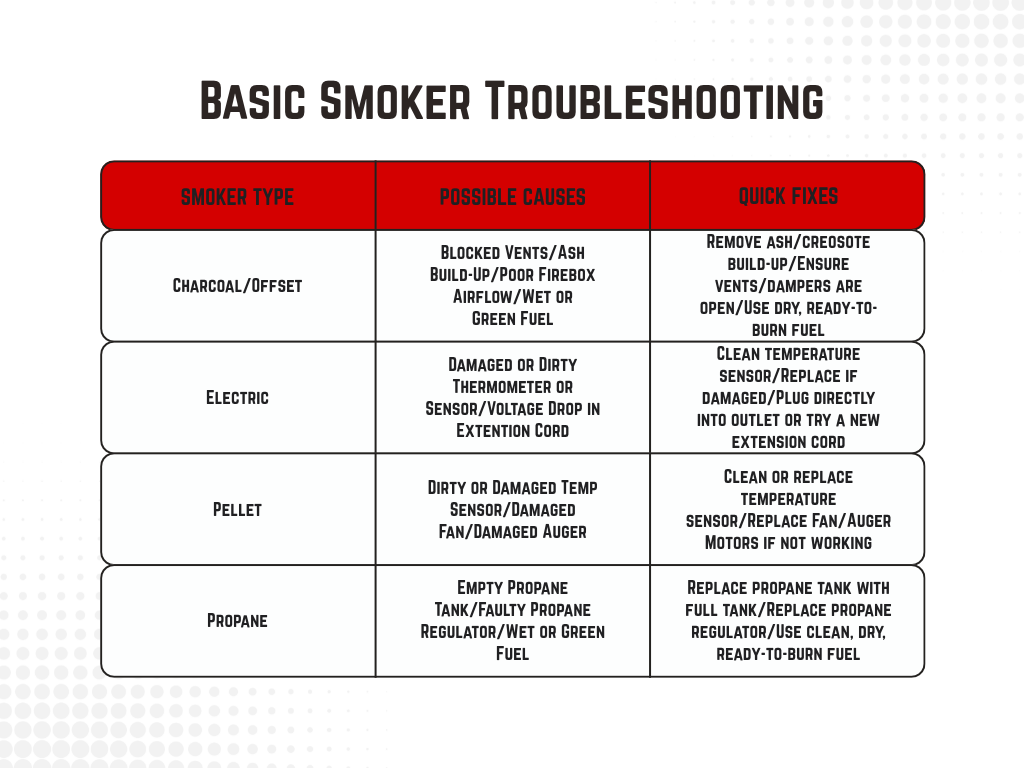
Have you been having trouble ensuring that your smoker is getting and staying hot enough? Are you worried that your food isn’t cooking as fast as you thought it would? There’s nothing more frustrating than meat stalling or a long cook getting interrupted. The good news, is that these issues can be fixed. Most of this issue is caused by airflow issues, fuel quality, or dirty sensors/thermometers. The 3 things that you need to keep in mind with fire are 1- Ignition 2- Oxygen 3- Fuel. Temperature issues are going to have to do with one of those 3 things.
Quick Troubleshooting Checklist
The 7 Quick Fixes
Fix #1– Clear out Accumulated Ash and Unblock Vents
– The Problem: Ash restricts airflow through the intake dampers, starving the fire of oxygen. No Oxygen=No Fire. If vents are blocked, proper airflow will be restricted to the ignition and fuel sources, choking out the fire, or restricting its heat. Once that happens, temperatures will either stall or decrease and flame out.
– Actionable Step: If you are mid-cook it’s a bit more complicated, but I like to use a metal fireplace shove to scrape out any ash that may be building up, restricting airflow. I move it to either a fire bit or a metal bucket where it won’t be a fire hazard.
– Pro Tip: Keep the exhaust vent mostly or all the way open, and control heat with the intake vents.
Fix#2– Switch Out Wet or Inferior Fuel (Pellets/Charcoal/Wood)
– The Problem: Damp pellets, poor-quality charcoal & wood, and wet wood will have a hard time igniting, and burning hot enough or efficiently enough
– Actionable Step: Inspect the pellets. They shouldn’t easily crumble or appear to be puffing up or swelling at all. If they are, remove them and discard. Replace the pellets with clean, dry, fresh pellets that will burn. Swap out any firewood that may have gotten wet by rain, snow, or irrigation. Use only firewood that has been sufficiently dried out. If it was recently cut down from a live tree, it will be too “green” to burn correctly or efficiently.
Fix #3– Check Your Valves and Fuel Levels
– The Problem: The flame won’t burn hot enough if the fuel source isn’t being sent to the burn area fast enough or consistently enough. If there isn’t enough fuel, you won’t get a good, strong burn either.
-Actionable Steps: Check the fuel level. You should be able to feel how empty or full the tank is by picking it up and lighting swinging it back and forth a bit. If you can’t hear the fuel moving around, the tank is empty, or almost empty. Either refill the tank or exchange it for a new, full tank. If you have fuel, try using a new propane regulator hose. These are inexpensive and simple to replace at the local hardware or bbq supply store. If the new regulator doesn’t do the trick, contact your smoker manufacturer about replacing the propane burner. If it appears the burner doesn’t have a full flame, try cleaning it gently with a wire brush. If that doesn’t do the trick, replace the burner.
Fix #4– Clean & Check Sensors and Probes
– The Problem: Sensors can easily be covered by grease, and creosote, resulting in inconsistent or incorrect temperature readings
– Actionable Steps: Very gently clean sensors with very fine sandpaper, or a cloth. Some sensors are extremely fragile, so do this gently, and carefully. If there is grease buildup, us a light amount of grill safe cleaner/degreaser. I recommend the Traeger spray cleaner. It is plant based, and safe in the cook chamber. If cleaning the sensors doesn’t do the trick, talk to your manufacturer about replacing the sensors. Tech support can usually get a new sensor sent your way for a reasonable price. Contact my Grill Service Department for a repair service if you don’t feel up to doing it yourself.
Fix #5– Plug Straight Into an Outlet or New Extension Cord
– The Problem: Extension cords can cause voltage drop if they are of low quality or old age. Voltage drop will cause the smoker to perform poorly.
– Actionable Steps: Plug the smoker straight into a properly installed outlet. This will reduce any kind of voltage drop caused by extension cords and power strips. You can try a new extension cord, but this could potentially cause more issues in the future with additional voltage drop. Instead, use a reliable power source like properly installed outlet. Talk to your electrician about your power needs for your pellet or electric grill/smoker.
Fix #6– Check Your Fans & Motors
– The Problem: Once a fire is established in the fire pot, it won’t last long if the fan motor isn’t blowing air into it. Likewise, the fire is going to burn out quick if the auger motor isn’t driving pellets into the fire pot.
– Actionable Steps: Pellet smokers are designed to get the majority of their airflow through fans, not natural airflow. If you don’t hear the fans spinning, you’ll need to look at getting them replaced. This is usually a relatively affordable and easy task to do. If you aren’t hearing the auger motor or seeing the auger spin, you aren’t getting the fuel needed to keep your smoker hot enough, or at all. Replacement parts are usually readily available for replacing the auger motor. If this is an intimidating step, make sure to reach out to my service department for a repair appointment.
Fix #7– Mind the Weather
– The Problem: We can’t control the weather. Sometimes wind, rain, snow, and moisture just make the cook tougher. Rapidly changing weather is the hardest to handle.
– Actionable Steps: Keep your smoker in a dry, covered area. This will prevent fuel sources from getting wet, and it will protect the smoker’s components from developing water damage. I always recommend covering your grill with a weather rated cover once it’s cooled down properly. If the elements strike while you are cooking, see if you can move the smoker to a safely covered area, that won’t be a fire hazard. Shift your smoker around as winds shift, so airflow is efficiently blowing through the intake dampers and vents.
Common Questions
Question: What temperature should my smoker be running at for low and slow BBQ?
Answer: Low and slow BBQ is usually defined between the ranges of about 175 Degrees F, and 235 Degrees F
Question: Why does my smoker drop temperature suddenly halfway through a cook?
Answer: Simply stated, you lose any, or any combination of the following: Oxygen, Fuel Source, Ignition. Check your fuel source. Maybe you ran out of pellets, charcoal, or wood. Check your airflow. Maybe you accidentally left vents and dampers closed. Check your ignition. Did you flame out? Did the fire get too wet?
Question: Can a bad controller cause an electric or pellet smoker to stay cold?
Answer: Absolutely. Not all issues can be tied to sensors. Many issues can be caused by a bad controller. It’s a mini computer, so naturally it can have any issues that electronics normally encounter. Most manufacturers are able to send you a new one. Make sure to ask them if it is still under warranty.
Conclusion
Start with diagnostics. It’s a frustrating time when your cook gets interrupted, but most issues are easily resolved when you take a closer look at the 3 key makeups of a good fire. Oxygen, Fuel, and ignition. These tips and tricks should help you solve a large majority of issues with your smoker, especially if you are wondering why your smoker isn’t getting or staying hot enough. There are other possible causes, but most of these tips should get you going in the right direction.
Make sure you tune in to my “How-To” page for other tips and tricks, and other answers to common BBQ questions.
Not sure what to cook up? Make sure to check out my recipe posts for a diverse offering of great ideas.
3 thoughts on “Why Is Your Smoker Not Getting Hot Enough? 7 Quick Fixes”