
How to Smoke a Brisket on a Pellet Grill
Smoking a full packer brisket is the ultimate test of backyard barbecue, but it doesn’t require culinary school or 20 years of fire-tending to get right. Achieving tender, juicy slices with a deep smoke ring and crisp bark comes down to temperature control, knowing when to wrap, and being patient during the rest.
This guide walks you through the exact cooking process—from trimming and seasoning to beating “the stall” and slicing across the grain.
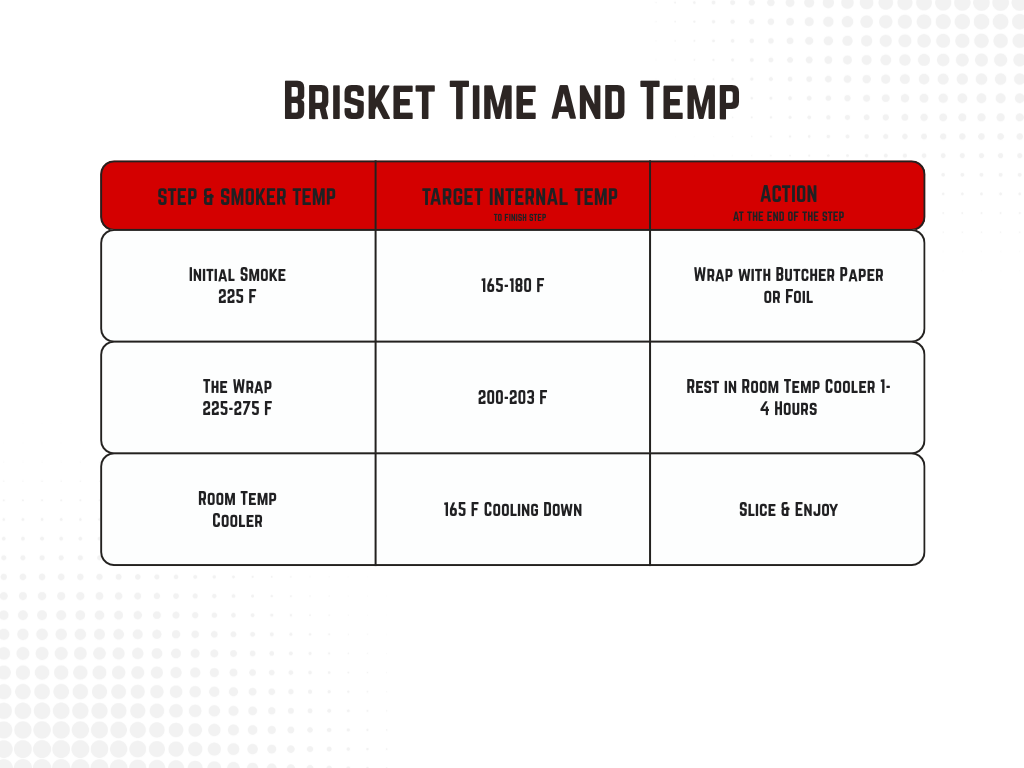
The Quick Breakdown: Time and Temp
Step 1: Trim and Season for Airflow and Bark
A clean trim ensures even cooking and prevents fat from pooling, which washes away your seasoning.
- Chill the Meat: Cold fat is firm and easy to slice. Keep the brisket in the fridge until right before trimming.
- Remove the Hard Deckle: Trim out the hard, gray kernel of fat between the flat and the point—it will not render down during cooking.
- Shape and Bevel: Round off sharp corners and trim the top fat cap down to an even 1/4-inch thickness across the flat.
- Apply Rub: Use coarse kosher salt and 16-mesh coarse black pepper (a standard 50/50 Texas-style dalmatian rub) or your favorite brisket blend. Coarse pepper is critical because it creates texture for smoke to cling to, building an authentic bark.
Step 2: The Initial Smoke (Setting the Bark)
Place the brisket fat-side down (or facing the direct heat source of your specific smoker) on grates running at a steady 225°F.
- Wood Selection: Oak, hickory, or pecan provide a balanced flavor profile without becoming bitter over a 12-to-16-hour cook.
- Spritzing: Leave the lid closed for the first 3 hours. After hour 3, check the surface. If edges look dry, spritz lightly with a 50/50 mix of apple cider vinegar and water or beef broth every 45 to 60 minutes.
- Watch the Color, Not Just the Clock: You are waiting for the bark to turn mahogany-black and adhere firmly to the meat. If you scratch the surface lightly with a fingernail and the rub doesn’t wipe off, your bark is set.
Step 3: Pushing Through “The Stall”
Around 150°F to 170°F, the internal temperature will stop climbing. This plateau, known as the stall, happens when evaporative cooling matches the heat input of the smoker. It can last anywhere from two to five hours.
Butcher Paper vs. Aluminum Foil: Which to Choose?
- Peach Butcher Paper: Breathable. It speeds up the cook while preserving the crisp, crunchy bark you built during the first phase.
- Aluminum Foil (The “Texas Crutch”): Completely seals in moisture and cooks the meat faster, but it steams the brisket, softening the bark.
Wrap the brisket tightly around the 165°F mark, tucking the edges beneath the meat so steam cannot easily escape. Return it to the smoker, bumping your smoker temperature up slightly to 250°F–275°F to render the remaining intramuscular fat.
Step 4: Probing for Tenderness (Not Just Internal Temp)
Internal temperature is a guideline; texture is the ultimate metric.
Begin probing the thickest part of the brisket flat through the paper when the internal temperature hits 198°F.
- The probe should glide in and out with zero resistance, feeling like warm butter or room-temperature peanut butter.
- If it pushes back or feels rubbery, let it cook for another 20 to 30 minutes and probe again. Most briskets finish between 202°F and 205°F.
Step 5: The Extended Rest (The Step Most Cooks Rush)
Slicing into a brisket straight off the grates causes all the rendered juices to spill across the cutting board, resulting in dry meat within minutes.
- Pull the wrapped brisket off the smoker and let it vent on the counter for 10–15 minutes to stop the carryover cooking process.
- Wrap the brisket in an old bath towel and place it inside a clean, dry, unheated cooler (a faux Cambro).
- Let it rest for a minimum of 2 hours, or up to 4–6 hours. During this period, the muscle fibers relax and reabsorb liquid, while the gelatin sets throughout the cut.
Step 6: Slicing the Flat and the Point
Brisket consists of two distinct muscles whose grains run in completely different directions: the lean flat and the fatty point.
- Use a long, scalloped or serrated slicing knife.
- Locate the grain of the flat and cut straight across it in slices about the thickness of a standard pencil (roughly 1/4 inch).
- Once you hit the point muscle, turn the brisket 90 degrees to cut across the point grain, slicing into slightly thicker pieces.
Troubleshooting Common Brisket Pitfalls
- Dry Flat: Brisket was likely undercooked (connective tissue didn’t render) or over-trimmed on the fat cap.
- Mushy Bark: Wrapped too early in aluminum foil before the exterior seasoning set firmly.
- Tough Chew: Sliced with the grain instead of against it, or pulled off the smoker before reaching probe-tender softness.